01
Judging went digital
Since April 2026, Formula DRIFT takes Line and Angle, 80 of 100 Pro qualifying points, from telemetry. Drivers now train for what the data sees.
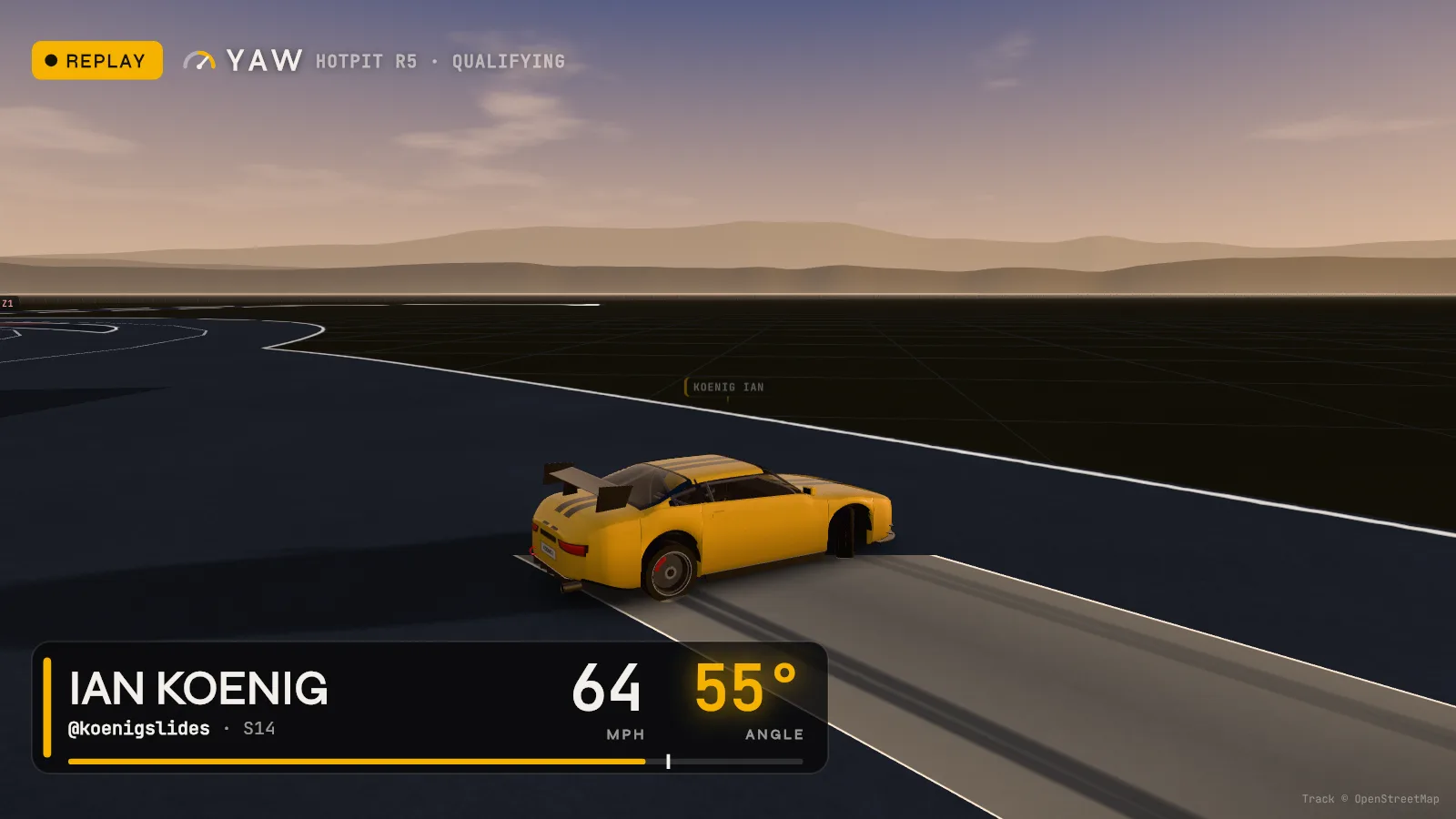
Ian's qualifying run, 10 to 18 seconds in, rebuilt by YAW from his phone alone, with the speed and angle overlay YAW lays over any video of a run. The car is YAW's stand-in.
YAW starts in drift: telemetry on the phone a driver already has, an event that runs itself, and a coach that remembers every run. It's built, it ran its first competition last week, and the next month puts it in front of strangers.
A slip angle is easy to copy. A driver's graded history, the events it was recorded at and the pairs of cars that battled aren't. That's a data company with a sensor attached, and drift is the place to start one.
Since April 2026, Formula DRIFT takes Line and Angle, 80 of 100 Pro qualifying points, from telemetry. Drivers now train for what the data sees.
Pro scoring hardware is fitted by officials and costs too much below the top tier. Lap-timing boxes don't measure drift angle.
The phone is already in the car. YAW is free to try from a QR code at the track. Hardware is an upgrade later, not the price of getting in.
Formula DRIFT has about 5M social followers. Every run is content, so the reel and the results sheet market YAW for us.
HOTPIT Autofest Round 5 at the Bullring, Las Vegas, 16–17 Oct 2026: Ian Koenig's S14, with YAW on the dash and nobody touching the phone. The clip at the top is his one qualifying run, rebuilt and read by YAW.
Hands-free recording, no lost runs, the data filed into the coaching vault within the hour.
The data showed Ian's phone reading angle high. YAW now learns each phone's order from the drive, and re-reads old runs.
On the one run that counted, YAW read 70 on zones it found from the day's own laps, and the judges gave 71. On the organizer's official layout it read 60. One run, so a first data point, not a claim.
Ian is the only driver who has used YAW at a competition. The first open day measures whether new drivers go out again with it.
Nothing is for sale yet. The prices are tests, not a business.
Ian's phone sent its rotation in an unusual order and read high until the data caught it. More phones need checking before a stranger's numbers are trusted.
An event that runs on YAW without either of us there.
Everything below works today; the tag is the release it shipped in. The headline of each, the rest a tap away.
The phone on the dash is the sensor. The work is reading it truthfully.
Drift angle (an estimate), speed and G: the motion sensors read 60 times a second, the GPS once, big enough to see from the corner of your eye. A run starts by itself when you roll.
Film a run from a still camera, tap the car's real angle frame by frame, and see YAW's reading beside it. Tried on test video so far; the first real check is at the next practice.
A phone's GPS says where you were a second or two ago. YAW learns that delay for each phone, and how the phone is mounted, and takes both out.
Some phones send their rotation in a different order. YAW works it out from the drive and remembers it for that phone; older runs are re-read in one tap. More phones still need checking.
After every run, the one thing to fix. Not a wall of numbers.
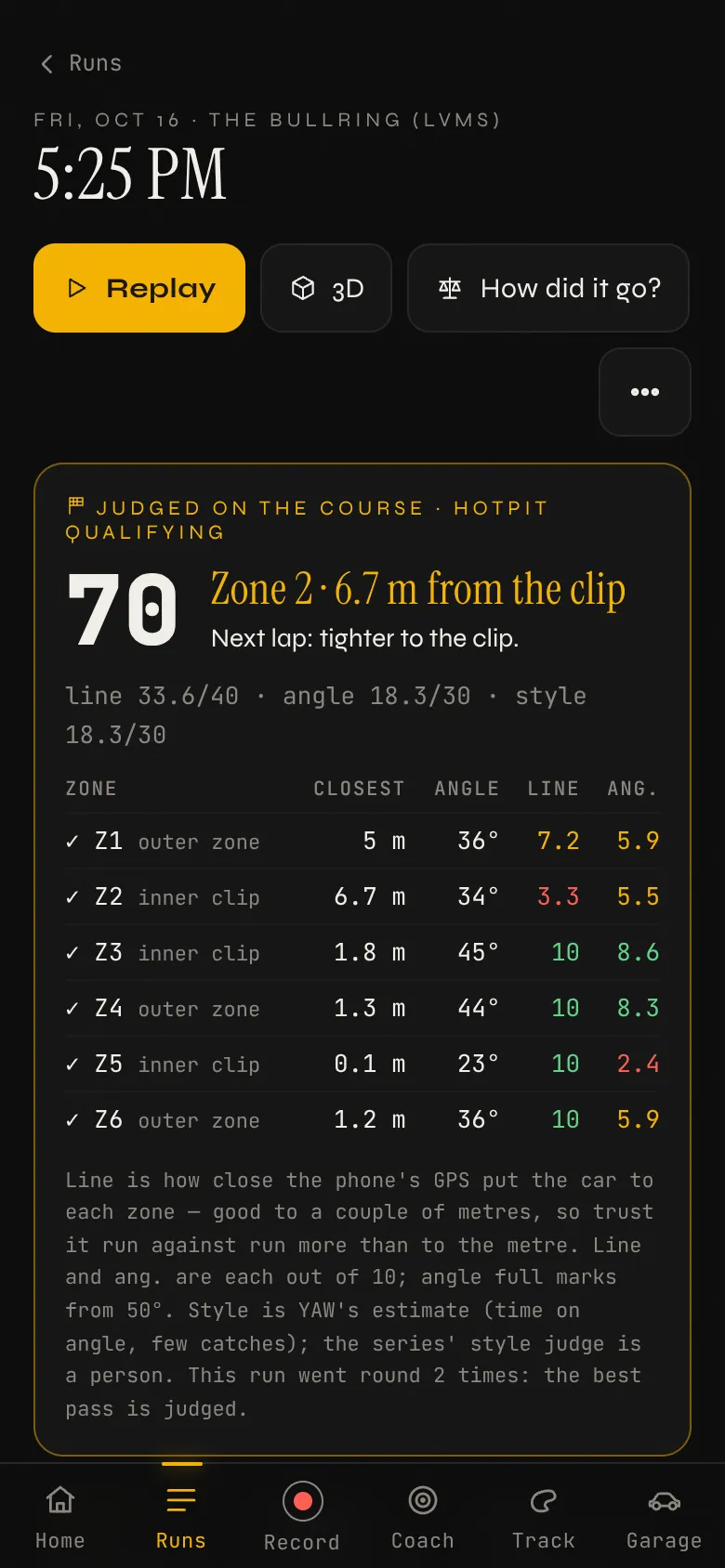
The score, the zone that cost the most and what to do next lap, first on the screen and said out loud when the run saves.
Line, angle and style on the course's zones, weighted like HOTPIT or Formula DRIFT, against your own best run at that track.
Each zone read against the line the field drove. Quiet while you're in the zones, then one call after the last: “Two. Wide.”
Tag the run that counted, add the judges' scores, and see YAW's read of it next to theirs.
One phone starts an event. Everything after that can run on YAW.
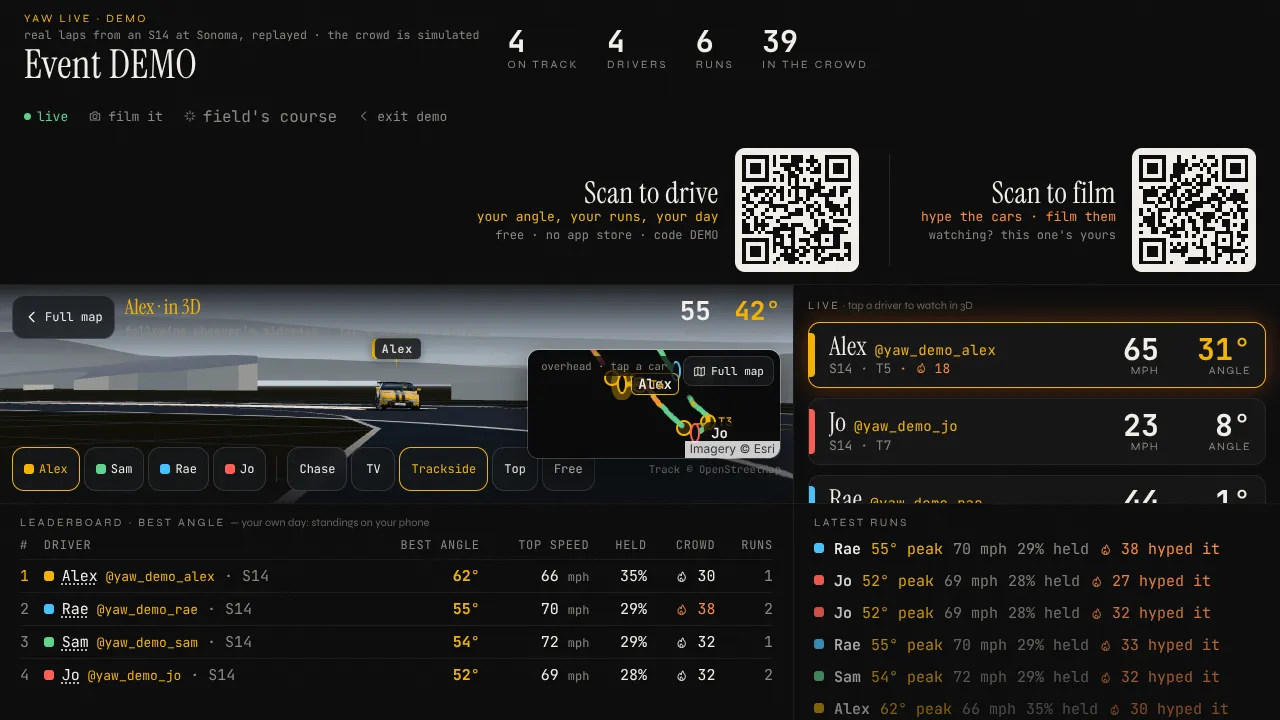
Start an event on any phone and open it on a TV. Drivers join by QR code, and every car shows live on the map with boards you can read across the tent.
Judges score every run on a tablet. The scores land on the big screen, the results and each driver's phone as they're given.
Every battle in 3D from the laps the event keeps: who led, how close the chase stayed and how much angle it held.
The zones are found from the laps everyone drives, and each track remembers its course for every phone that goes there.
Seeded from qualifying, battles called by the judges' votes, and every battle run tagged by itself.
Pick the lead car on the event. The chase phone measures the gap, how close it stayed and how well it matched the angle.
Every run is content. YAW cuts it for you.
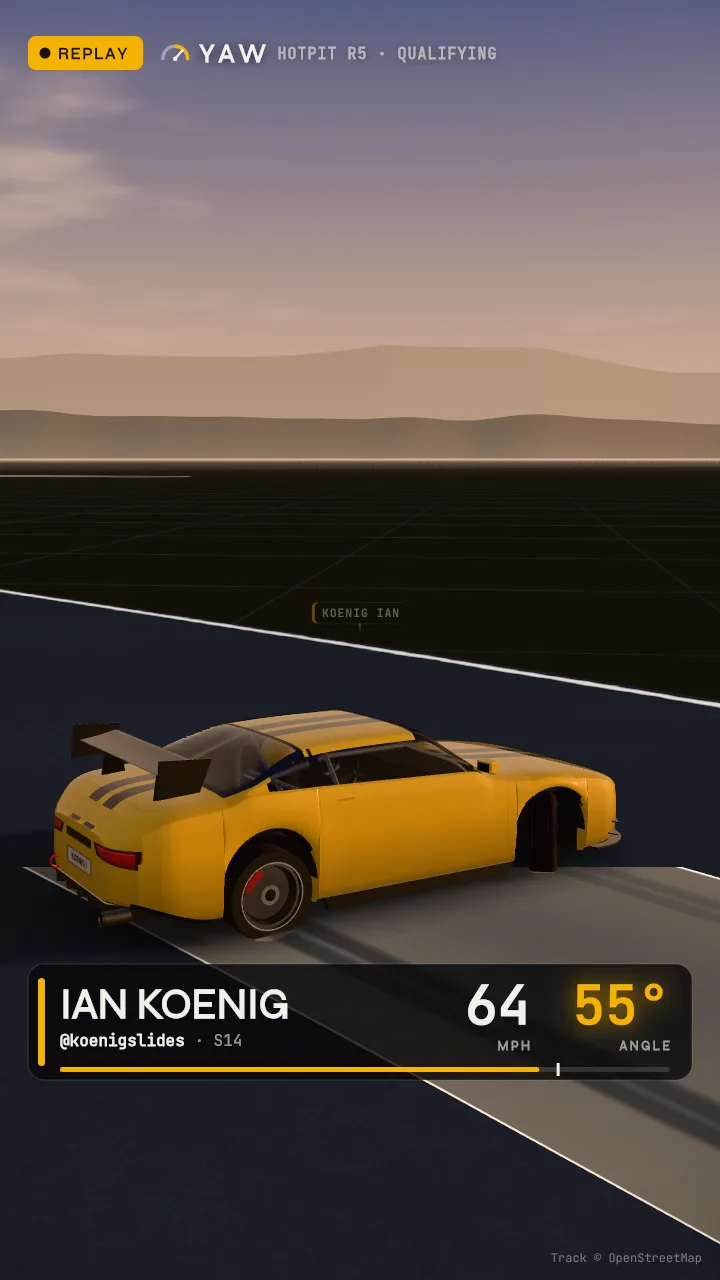
Anyone's camera, with the car's name, speed and angle burned into the video. The crowd taps to hype the car on track.
The day's best moments cut into one 9:16 video on the phone, ready to post.
Live numbers over an event's stream, and a commentator's screen with the storylines of the day.
A small team with production habits.
A static app and one Cloudflare relay, on the free tier. The paid tier is $5 a month when events grow.
Every deploy runs the full test suite first and stops if one test fails.
Every hour, a job pulls shared runs into the coaching vault and writes each driver's debrief and the day's read.
The same pages in an iOS app, set up and ready to sign.
No account, no ads, no trackers. Runs live on the phone, and sharing them is a switch the driver turns on.
Every price below is a test this month, not a decision. Drivers try YAW for nothing, at the track, from a QR code.
Recording, your runs, getting them out and your place on an event's board stay free for good.
The paid layer on top of the free app. To test with thirty drivers this month.
The big screen, judging, the bracket and the results sheet, for an organizer. To test with ten organizers.
Later, and only once demand is proven: 25 Hz GPS, motion and the engine's data in one box.
Drift alone is a good small company. The second ring is where a venture outcome lives.
Others measure. Nobody else runs the day.A season of graded runs and benchmarks doesn't move to a rival's app.
Courses per track, organizers' habits, the 5 pm results sheet as a ritual.
Two-car data exists only when both cars run YAW, so each event makes the next more useful.
Limit-handling data at scale, if consent is designed in now. It's on this month's plan.
Hard-won, but a funded team could rebuild it in a year. We don't lean on it.
Prove strangers come back.
60% go out again, 25% return to the next event, an organizer pays without being chased.
Own the sensor.
About $1M a year in revenue, pods shipping, three series partners.
Leave drift without leaving it behind.
50,000 active drivers and a series paying for judging help.
The record of driving at the limit.
A first carmaker or tire-maker contract.
What we're shipping, building and testing over the next four weeks, soonest first.
Out to everyone on 18 Oct (v129): the gyro fix, the sharing fix, the one-line read, and runs put on the course's route. v130 re-reads a phone's older runs in one tap.
Run again on the corrected angle (v129): 70 on the zones the day's own runs found, against the judges' 71. The phone's quicker read, against his own best run, says 84: it runs high, so the course read is the one we quote.
A real domain before strangers install. Moving is built: runs and set-up come across in one tap.
Roles, equity and the code's ownership on one page with Ian, and the YAW name searched for software.
Ian and the test drivers get the App Store build first. The app is set up in the code (v124); Xcode, Apple's developer account and signing on the Mac are next.
One tap before the number, so you read your own feel first. Then why the second lap dropped: on Friday it dropped about 14 points an outing, part of that the GPS (being checked).
YAW tried on more iPhones and Androids, and a phone on a tripod at the next practice for the first real angle-against-video figure.
An open practice day with 8 or more drivers, most of them new to us. YAW runs the big screen and the results sheet, and counts who goes out again. The date is the next day Ian enters.
Which part of the read each run opened, sent with the report the event already gets, and said on the privacy page first.
Ten organizers and thirty drivers asked about three prices: $89 a year for a membership, $99–199 an event for an organizer, $249 for a pod.
A separate opt-in to give runs to a research dataset, so the data can become an asset later without surprising anyone.
Written 18 Oct 2026 for the month to 18 Nov. Dates are targets; safety and the angle come first, so nothing ships on a day Ian is at the track.
Who's doing it.131 releases in 18 weeks, each with its tests. Found the iPhone's GPS lag in real track data and, the day after Ian's first competition, the phone quirk that read his angle high.
HOTPIT Autofest Pro class in an LS3-swapped S14. Top 32 at LS Fest Las Vegas 2026. Every feature is tried in his car first.
Organizers who'd run a day on YAW, drivers who'd try it, and people in the scene who back things like this.
What would you need to see from the first three open days to put money in?
We raise nothing until strangers come back. Then a first round of pre-orders and angels, up to $150k.
Tell Griffin in the room, or reply to the message that brought you here. The next conversation starts with the first open day's numbers.
Put YAW on your own phone. The demo event replays real laps on a real track, big screen and all.